



Solutions
From product selection and quality documentation to packaging and delivery, we help customers build a more reliable chemical supply chain.
How to select personal care ingredients for a stable emulsion
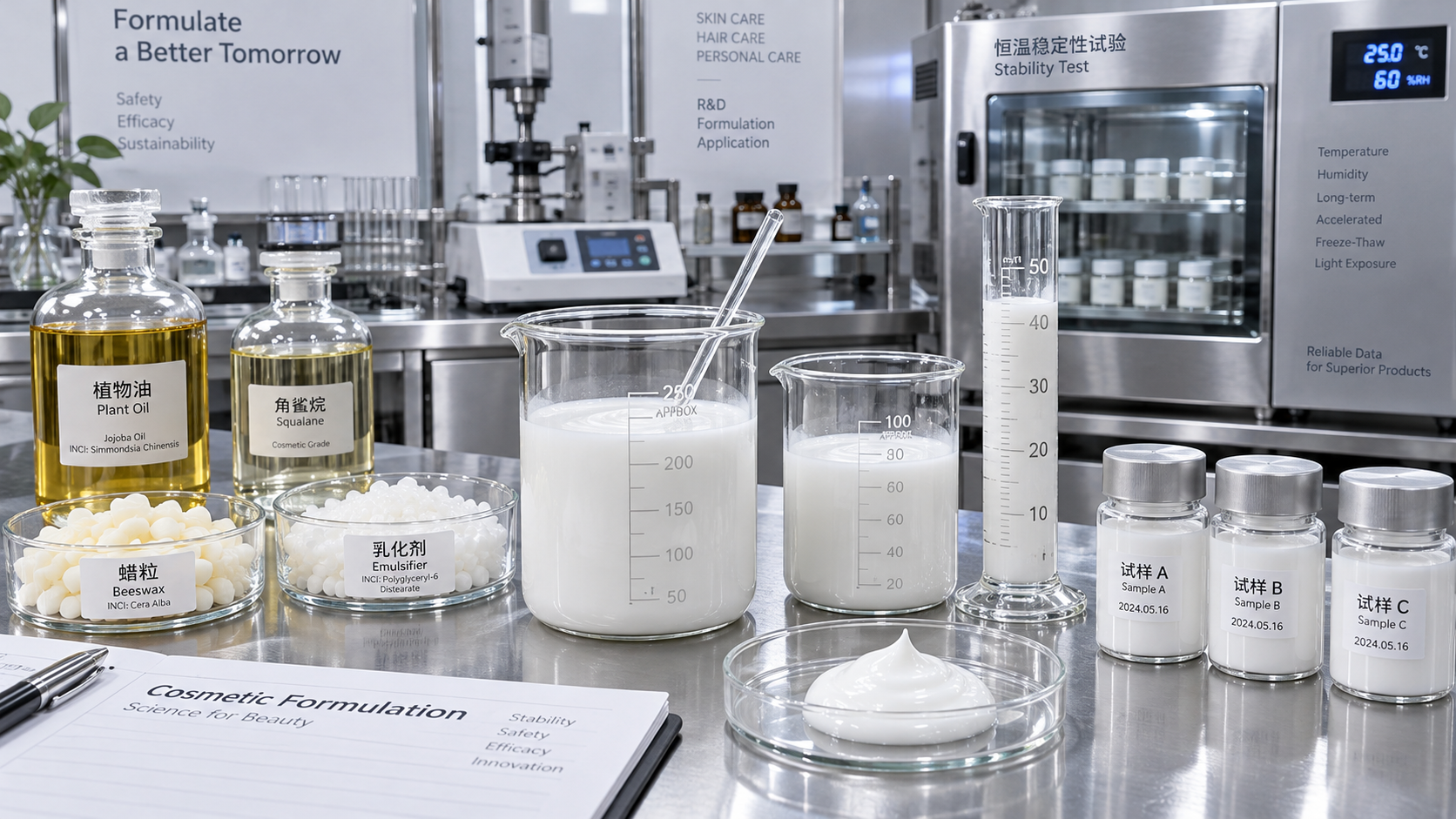
Emulsion stability is determined by the whole formulation system, not by the emulsifier alone. A personal care emulsion can look smooth immediately after manufacture yet separate, thin, grain, discolor, or lose viscosity after storage because the selected ingredients do not remain compatible across pH, temperature, ionic strength, and processing conditions. The practical selection question is therefore not “which emulsifier works,” but “which ingredient set remains stable in the intended product and manufacturing window.”
The starting point is to define the emulsion architecture: oil-in-water (O/W), water-in-oil (W/O), or a more complex multiple emulsion. O/W systems are common for lotions, creams, cleansers, and many serums because they provide a lighter sensory profile and are generally easier to rinse from skin. W/O systems can offer greater water resistance and a richer skin feel, but typically require different emulsifier chemistry, tighter processing control, and more careful evaluation of the water phase.
Match the emulsifier system to the real oil phase
HLB remains a useful screening tool for conventional emulsions, but it should not be treated as a complete selection rule. The required HLB of an oil phase is influenced by the combined composition of esters, hydrocarbons, triglycerides, silicones, waxes, UV filters, fragrances, and oil-soluble actives. A formulation containing only a light ester blend behaves differently from one containing fatty alcohols, butters, high-polarity esters, and crystalline waxes, even when both appear to have a similar calculated HLB requirement.
Nonionic emulsifiers are widely used because of their broad pH tolerance and compatibility with many cosmetic ingredients. However, their performance can still be affected by electrolytes, high levels of polyols, surfactants, or certain preservatives. Polymer-assisted emulsifier systems may improve robustness at low use levels, but their viscosity response can depend strongly on neutralization, shear, and the electrolyte load. Lamellar emulsifier systems can provide an elegant cream structure, yet they require an appropriate balance of fatty alcohols, co-emulsifiers, and processing temperatures.
A stable selection process evaluates the emulsifier with the complete intended oil phase, not with a simplified substitute. Replacing a supplied ester, fragrance, or silicone late in development can shift interfacial behavior enough to invalidate earlier stability results.
Separate emulsification from viscosity building
A frequent formulation error is to use viscosity as evidence of emulsion stability. A thick product may still exhibit droplet coalescence, creaming, or phase separation over time. Conversely, a low-viscosity lotion can be stable if droplet size, interfacial film strength, and rheology are properly controlled.
Personal care ingredients used for rheology modification should therefore be selected for more than initial viscosity. Carbomer-type polymers, associative acrylic thickeners, xanthan gum, cellulose derivatives, and modified starches differ in salt tolerance, pH response, sensory profile, clarity, and compatibility with surfactants. For example, a polymer that gives high viscosity in deionized water may lose structure when botanical extracts, neutralized actives, salts, or cationic materials are introduced. Fatty alcohols and waxes can reinforce a cream network, but excessive levels may create drag, soapiness, crystallization issues, or temperature-sensitive viscosity changes.
The desired rheology should be defined in use terms: pumpability, spreadability, suspension of insoluble materials, resistance to creaming, and recovery after shear. A single Brookfield viscosity value does not capture these properties.
Check pH, electrolytes, and active-material compatibility early
pH is a formulation variable rather than a final adjustment. It affects polymer swelling, preservative performance, the ionization of organic acids and bases, emulsion charge, and the stability of certain actives. If the product must operate within a narrow pH range, the emulsifier and thickener should be screened at that range from the beginning.
Electrolytes deserve the same attention. Sodium chloride, magnesium salts, mineral-rich extracts, buffering agents, neutralized acids, and some protein hydrolysates can destabilize polymer networks or alter emulsion droplet interactions. Cationic conditioning agents can also conflict with anionic rheology modifiers or surfactant systems. Ingredient compatibility should be assessed at commercial use concentrations, including expected batch-to-batch variation in natural extracts and fragrance compositions.
Preservative selection must be considered as part of this compatibility work. Some preservative blends have limited solubility, can partition into the oil phase, or can alter odor, color, and viscosity. A technically stable emulsion is not a viable product if the preservation system cannot perform within its pH and packaging conditions.
Processing conditions are part of ingredient selection
Ingredients that appear compatible on paper may fail under the actual manufacturing process. The required heating temperature must accommodate the melting behavior of waxes, fatty alcohols, and emulsifiers without exposing heat-sensitive actives, fragrances, or botanical materials to unnecessary stress. Homogenization energy affects droplet size, but excessive shear can reduce viscosity in some polymeric systems, introduce air, or damage fragile lamellar structures.
Order of addition is equally important. Pre-dispersing gums, properly hydrating polymers, dissolving oil-soluble materials before emulsification, and cooling under controlled agitation can determine whether the same raw materials produce a uniform product or an unstable one. A lab-scale formula should be evaluated using a process that reasonably represents the intended manufacturing equipment; otherwise, scale-up risk remains hidden.
Use stability testing to reject weak systems, not merely confirm appearance
Initial visual assessment should be followed by storage under ambient, elevated, and low-temperature conditions appropriate to the product category. Monitoring should include phase separation, viscosity drift, pH movement, color and odor change, centrifuge response where relevant, and microscopy when droplet growth or crystal formation is suspected. Freeze–thaw cycling can be informative for products likely to encounter low-temperature distribution conditions, but it should not be used as the only predictor of shelf stability.
The strongest ingredient choice is usually the one with adequate stability margin rather than the one that gives the best appearance on the day of manufacture. Selecting personal care ingredients on that basis reduces late reformulation caused by a new fragrance, active, packaging format, or manufacturing-scale change.
Related Posts
- ▶ How to Assess Traceability and Supply Risk When Sourcing Plant Extracts
- ▶ What Documentation Should Quality Teams Require for Personal Care Ingredients?
- ▶ Selecting Dyestuffs and Pigments for Plastics: Lightfastness, Migration, and Heat Stability
- ▶ When rising personal care ingredient prices require formula changes
- ▶ What causes shade variation in dyestuffs and pigments?
- ▶ How batch variability affects pharmaceutical raw material quality