



Solutions
From product selection and quality documentation to packaging and delivery, we help customers build a more reliable chemical supply chain.
How to assess fragrance stability in a finished product

How to Assess Fragrance Stability in a Finished Product
A fragrance can smell excellent in its original concentrate yet behave very differently after it enters a finished product. In a liquid soap, cream, detergent, aerosol, or air-care formulation, the scent is exposed to water, surfactants, solvents, preservatives, pigments, packaging, and changing storage conditions. For quality control and safety teams, fragrance stability is therefore not a single pass-or-fail test. It is a practical assessment of whether the product keeps an acceptable odor, appearance, and safety profile through its expected shelf life.
The starting point should be a defined reference sample. Record the fragrance batch, dosage, base formula revision, manufacturing date, fill weight, and packaging format. A retained sample of the freshly made product is essential: without a clear baseline, later odor changes become subjective and difficult to trace.
Test the Formula, Not Only the Fragrance Oil
Stability screening on the fragrance oil alone can identify obvious oxidation or color drift, but it cannot predict finished-product performance. The same fragrance may remain clean and bright in an anhydrous product while losing top notes in a high-water formulation. In alkaline cleaners, certain materials may degrade or shift in character. In emulsions, poor solubilization can cause haze, separation, or fragrance concentration at the surface.
Prepare representative pilot batches using the intended manufacturing process where possible. Small laboratory samples are useful, but mixing energy, addition order, heating time, and cooling profile should reflect production reality. A fragrance added too early during a hot process may show a problem that is caused by process conditions rather than the fragrance selection itself.
Build a Storage Plan Around Real Risks
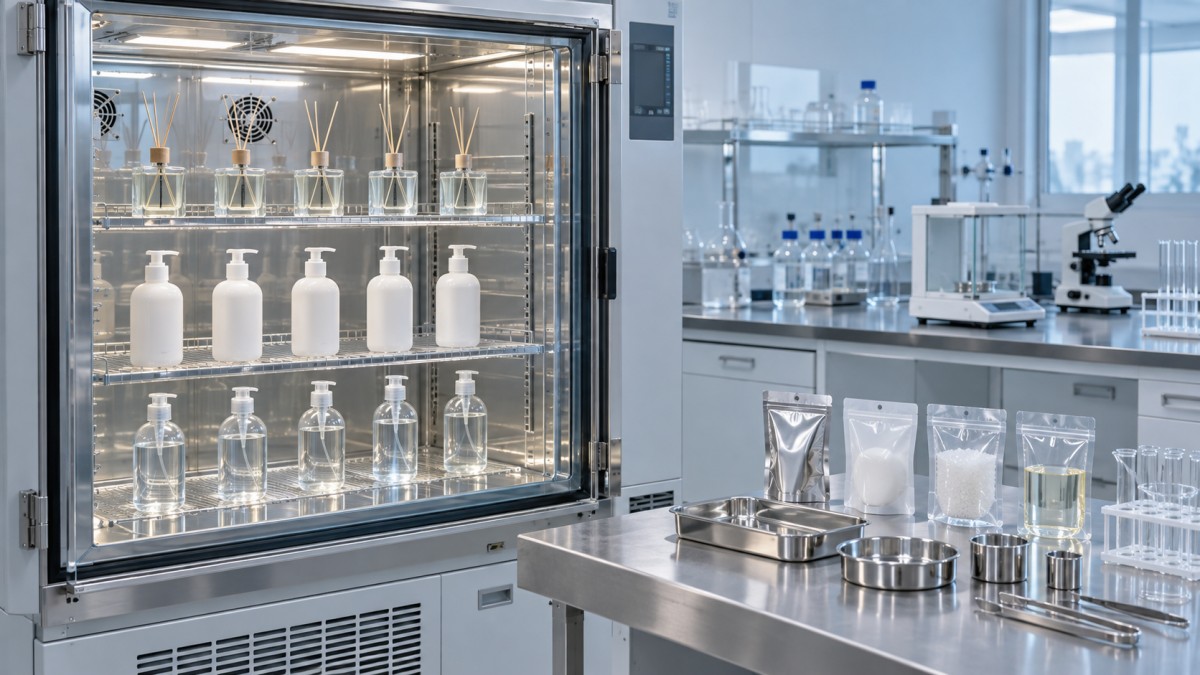
A useful study normally combines ambient retention with accelerated storage. Elevated temperature can reveal oxidation, hydrolysis, phase instability, and loss of volatile notes sooner, but it should not be treated as a simple mathematical substitute for real-time shelf life. Light exposure is especially relevant for clear packs, products displayed near windows, and formulas containing light-sensitive colorants or botanical components.
Include the final package whenever possible. Fragrance compounds can interact with closures, liners, pumps, labels, and plastic containers. Potential signs include paneling, leakage, softening, discoloration, stress cracking, or a changed odor caused by absorption into the package. Glass, polyethylene, polypropylene, and other materials can behave differently, so packaging compatibility should be confirmed for the selected system rather than assumed from a similar product.
What to Inspect at Each Checkpoint
- Odor profile: loss of freshness, harsh notes, rancidity, off-notes, or an altered dry-down.
- Appearance: color shift, cloudiness, sediment, crystals, foam changes, or phase separation.
- Physical properties: pH, viscosity, density, and any specification relevant to the product type.
- Package condition: leakage, deformation, closure performance, and interaction at the contact surface.
- Safety-related changes: unexpected instability, pressure buildup where relevant, or signs requiring further compatibility review.
Sensory evaluation should be controlled as far as practical. Use the same trained assessors, product amount, evaluation method, and comparison reference. Blind comparison helps distinguish a genuine fragrance shift from expectation bias. Where a formula is particularly sensitive, instrumental testing may support investigation, but analytical results should be interpreted alongside what consumers would actually smell in use.
Investigate the Cause Before Changing the Fragrance
When instability appears, the fragrance is not automatically the root cause. Check pH drift, preservative compatibility, raw material changes, metal contamination, oxidation of oils or surfactants, and deviations in manufacturing temperature. Review whether the issue occurs in all packs or only one packaging material. This approach avoids unnecessary reformulation and makes corrective action more defensible.
For Flavors and Fragrances used in regulated consumer applications, the assessment should also connect with the product’s safety and compliance review. Intended use level, market requirements, fragrance documentation, allergen considerations where applicable, and finished-product labeling all need alignment. Stability testing cannot replace a safety assessment, but it can expose conditions that make the original assessment less representative.
Jinan Suyu Chemical Co., Ltd. supports chemical procurement by coordinating sourcing, specification confirmation, quality documentation, packaging, and international delivery across daily chemical ingredients, Flavors and Fragrances, and other chemical raw materials. For a stability project, the most useful information to confirm early is the finished-product base, target pH, process temperature, fragrance dosage, pack material, storage expectations, and destination-market documentation needs. Those details provide a sounder basis for selecting materials and planning the right compatibility work.
Related Posts
- ▶ How to Assess Traceability and Supply Risk When Sourcing Plant Extracts
- ▶ What Documentation Should Quality Teams Require for Personal Care Ingredients?
- ▶ Selecting Dyestuffs and Pigments for Plastics: Lightfastness, Migration, and Heat Stability
- ▶ When rising personal care ingredient prices require formula changes
- ▶ What causes shade variation in dyestuffs and pigments?
- ▶ How batch variability affects pharmaceutical raw material quality